> ## Documentation Index
> Fetch the complete documentation index at: https://docs.bioptimus.com/llms.txt
> Use this file to discover all available pages before exploring further.
# H-Optimus
> A vision foundation model for histology feature extraction.
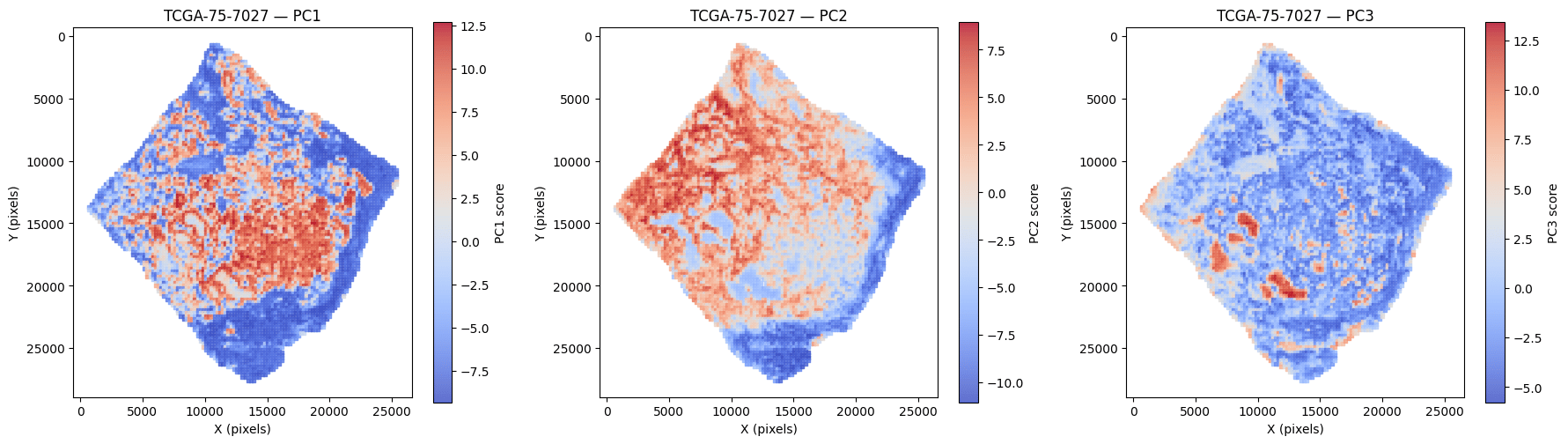
H-Optimus is a vision transformer foundation model for histology. It extracts tile-level **feature vectors (embeddings)** from H\&E whole slide images — the input to downstream tasks such as mutation prediction, survival analysis, and tissue classification. H-Optimus produces features; it does not predict molecular signal directly (for that, see [M-Optimus](/documentation/models/m-optimus)).
**H-Optimus-1** is current — a 1.1B-parameter vision transformer (ViT-g/14) trained with self-supervised learning on billions of tiles from over 1 million slides of more than 800,000 patients, spanning 50+ organs, 3 scanner types, and 4,000+ clinical centers. As of May 2026 it ranks **#1** on the public PathBench leaderboard and is the top image-only model on HEST. **H-Optimus-0** (2024) is the previous generation, open-source under Apache 2.0. See [Benchmarks](/documentation/models/benchmarks) and the [Hugging Face model details](/deployment/platforms/hugging-face).
 ## Specifications
| Property | Value |
| -------------------- | --------------------------------------- |
| Task | Tile embedding |
| Input | 224×224 RGB tile at 0.5 µm/px |
| Output | 1536-dimensional feature vector |
| On-prem endpoint | `POST /api/embed/h1` |
| SageMaker dispatch | `model_name: "h1"`, `mode: "embedding"` |
| Recommended instance | `ml.g5.xlarge` |
## How it's used
Run [tissue segmentation](/documentation/models/tissue-segmentation) to keep tissue-bearing tiles.
Embed 224×224 tiles to get a 1536-d vector each (the [SDK](/guides/get-started/sdk) tiles and dispatches for you).
Aggregate embeddings for slide-level prediction, retrieval, or classification.
## Deploy
H-Optimus runs on AWS SageMaker, on-premise, or Hugging Face (academic). See the [Deployment overview](/deployment/overview) for the full comparison and setup steps.
## Guides
Extract embeddings and visualize morphology.
Run whole-slide inference with the Bioptimus SDK.
## Specifications
| Property | Value |
| -------------------- | --------------------------------------- |
| Task | Tile embedding |
| Input | 224×224 RGB tile at 0.5 µm/px |
| Output | 1536-dimensional feature vector |
| On-prem endpoint | `POST /api/embed/h1` |
| SageMaker dispatch | `model_name: "h1"`, `mode: "embedding"` |
| Recommended instance | `ml.g5.xlarge` |
## How it's used
Run [tissue segmentation](/documentation/models/tissue-segmentation) to keep tissue-bearing tiles.
Embed 224×224 tiles to get a 1536-d vector each (the [SDK](/guides/get-started/sdk) tiles and dispatches for you).
Aggregate embeddings for slide-level prediction, retrieval, or classification.
## Deploy
H-Optimus runs on AWS SageMaker, on-premise, or Hugging Face (academic). See the [Deployment overview](/deployment/overview) for the full comparison and setup steps.
## Guides
Extract embeddings and visualize morphology.
Run whole-slide inference with the Bioptimus SDK.